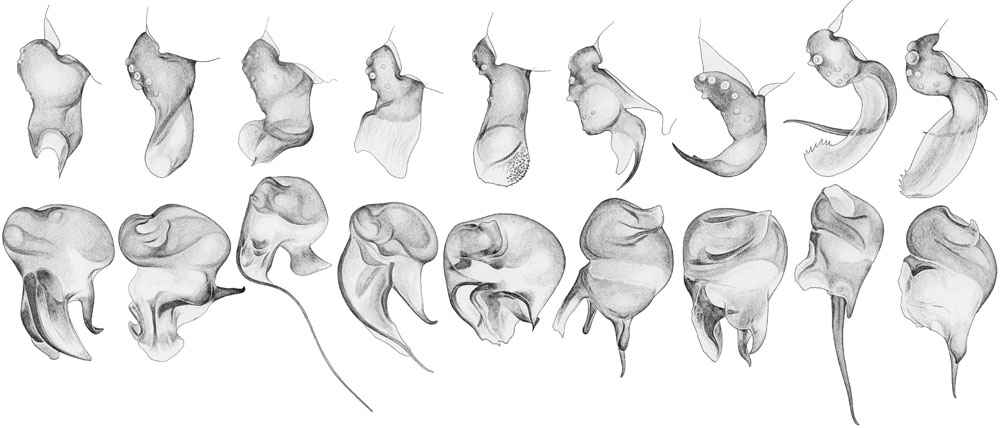
 Despite of their small size,
males are fairly easy to distinguish, mainly by their palpal strctures
(above). Females, on the other hand, are partly indistinguishable
morphologically. We used CO1 barcodes to support species limits. In
addition, we evaluated the potential effects of future climate change
on the environmental niche occupied by three selected Kambiwa species. Our results show
an altitude-mediated response to climate change. For a highland
species, areas of high habitat suitability almost disappear under more
severe climate change scenarios. For two species with lowland records,
the areas with high habitat suitability increase significantly.
Despite of their small size,
males are fairly easy to distinguish, mainly by their palpal strctures
(above). Females, on the other hand, are partly indistinguishable
morphologically. We used CO1 barcodes to support species limits. In
addition, we evaluated the potential effects of future climate change
on the environmental niche occupied by three selected Kambiwa species. Our results show
an altitude-mediated response to climate change. For a highland
species, areas of high habitat suitability almost disappear under more
severe climate change scenarios. For two species with lowland records,
the areas with high habitat suitability increase significantly.This contribution concludes a series of publications on the subfamily Ninetinae. We use this opportunity to summarize current knowledge about the subfamily, to discuss open questions and knowledge gaps, and to suggest further research topics focusing on these tiny but exceptional pholcids.
.